

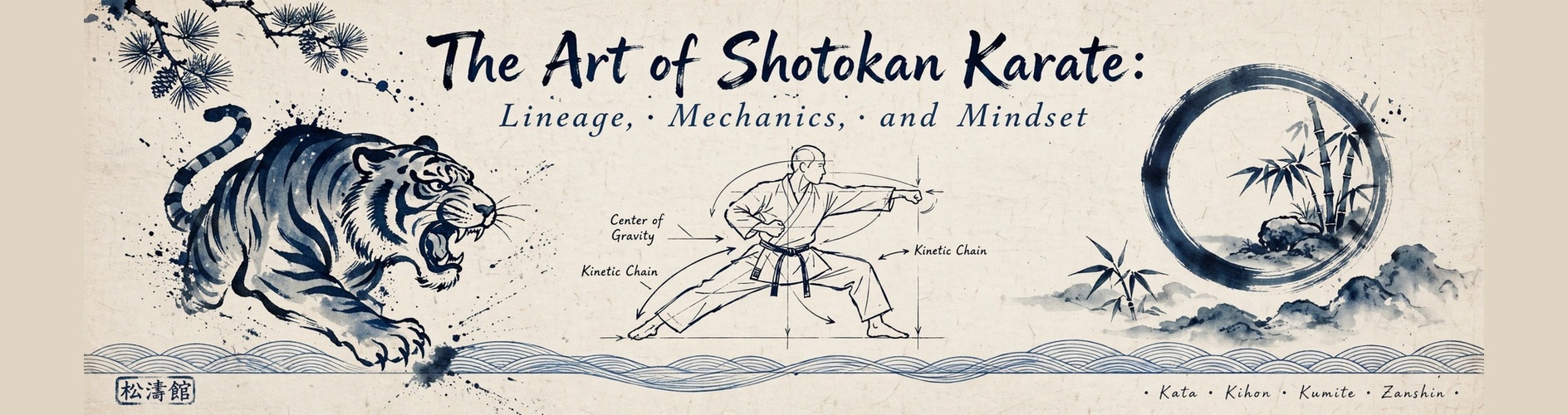
The Art of Shotokan Karate: Lineage, Mechanics, and Mindset
Shotokan Karate (松濤館) stands as one of the most widely practiced and respected traditional martial arts in the world. Characterized by its dynamic linear movements, deep stances, and uncompromising commitment to mental discipline, Shotokan is far more than a system of self-defense—it is a lifelong path of personal growth, character development, and physical mastery (Budo).
1. Origins and Lineage
The roots of Shotokan trace back to the island of Okinawa, where indigenous fighting techniques (Te) merged with Chinese martial arts influences. In the early 20th century, Master Gichin Funakoshi (1868–1957)—a schoolteacher from Okinawa—brought this art to mainland Japan.
Funakoshi believed that karate should serve to build character, physical health, and mutual respect. In 1939, his students established the first official head dojo in Tokyo, naming it the Shotokan (Shōtō, meaning "Pine Waves," was Funakoshi’s poetic pen name, and Kan means "Hall").
Together with his son, Yoshitaka Funakoshi, who introduced lower stances, long-range kicks, and explosive dynamics, Master Funakoshi modernized the system into the structured Japanese discipline recognized today.
2. The Three Pillars of Training (Sanbon-ba)
Shotokan training relies on three interconnected pillars, each building upon the other to forge a balanced martial artist:
Kihon (基本 — Fundamentals)
Kihon is the repetitive practice of isolated stances, punches, blocks, strikes, and kicks. Through line drills, practitioners refine body alignment, breath control, hip engagement (koshino kaiten), and the rapid transition from relaxation to tension at impact (kime).
Kata (形 — Forms)
Kata consists of choreographed sequences of defensive and offensive movements against imaginary opponents. Shotokan preserves over 25 core kata—ranging from fundamental patterns like the Heian series to advanced kata like Kanku-Dai, Jion, and Hangetsu. Kata practice instills muscle memory, rhythm, balance, and tactical awareness (bunkai).
Kumite (組手 — Sparring)
Kumite translates formal technique into dynamic application. Shotokan employs a structured progression:
-
Gohon & Sanbon Kumite: Five-step and three-step basic sparring for distance and timing.
-
Ippon Kumite: One-step sparring focusing on single, decisive defenses and counter-strikes.
-
Jiyu Ippon Kumite: Semi-free sparring with continuous movement and announced attacks.
-
Jiyu Kumite: Unscripted free sparring emphasizing control (sundome), strategy, and real-time adaptability.
3. Technical Mechanics: Power Through Structure
What sets Shotokan apart technically is its emphasis on strong foundation and full-body kinetic energy:
-
Deep, Grounded Stances: Stances like Zenkutsu-dachi (forward stance), Kokutsu-dachi (back stance), and Kiba-dachi (horse-riding stance) lower the center of gravity, forging leg strength and maximum stability.
-
Hip Dynamics: Power does not come from the arms alone, but from the explosive rotation and snap of the hips.
-
Hikite (Pulling Hand): As one hand strikes or blocks, the opposite hand chambered sharply at the hip creates a counter-balancing reactionary force.
-
Ikken Hissatsu (To Defeat with One Blow): The principle that every technique should be executed with maximum focus, efficiency, and intent.
4. Budo Philosophy and Dojo Etiquette
At its core, Shotokan is a philosophical discipline guided by the Dojo Kun (dojo rules) and the Niju Kun (Twenty Precepts of Karate) articulated by Master Funakoshi.
The central tenet of Shotokan philosophy is encapsulated in the famous phrase:
"Karate ni sente nashi" — There is no first strike in karate.
This principle reminds martial artists that karate is fundamentally defensive, intended to resolve conflict and preserve peace rather than incite violence. Through rigorous physical training, the practitioner learns patience, humility, self-control, and respect (Rei) for others—both inside and outside the dojo.