The Center on Main™ in Verrado®
4239 N Village Street
Buckeye, AZ 85396

Monday and Friday
7:30 pm - 8:30 pm

The Center on Main™ in Verrado®
4239 N Village St
Buckeye, AZ 85396

Monday and Friday
7:30 pm - 8:30 pm

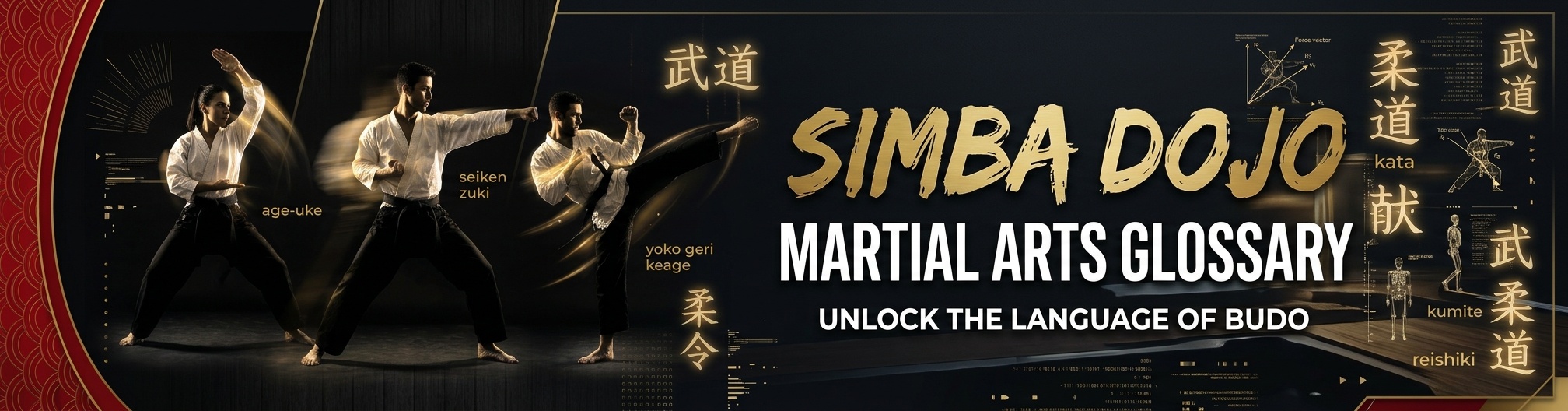
simba dojo glossary banner v2

Kihon kumite

Search for glossary terms (regular expression allowed)

Glossaries

Term Definition
Kihon kumite

Kihon-Kumite (基本組手), translated as "Basic Formulated Sparring" or "Fundamental Partner Drills," is the structured, pre-arranged sparring methodology in traditional Shotokan Karate designed to bridge isolated technique drills (kihon) and unscripted free sparring (jiyu-kumite).

Etymology & Structural Breakdown

  • Kihon (基本): "Basics" or "Fundamentals."

  • Kumi (組): "Meeting," "braiding," or "pairing together."

  • Te (手): "Hand."

  • Literal Meaning: Paired hand drills built upon fundamental techniques.

Key Mechanics & Structure

  • Pre-Determined Attacks & Targets: Both the attacker (tori) and defender (uke) know in advance the exact technique, target level (jodan, chudan, or gedan), step count, and rhythm to be executed.

  • Formal Announcement (Jodan Oi-Zuki!): Before attacking, tori steps into a strong guard (kamae), targets the area, and vocally announces the intended attack to ensure clarity and safety.

  • Controlled Counter & Kiai: The defender steps back or off-angle into a solid stance to execute a definitive block, immediately followed by a decisive counter-strike accompanied by a sharp kiai, stopping just short of target contact (sun-dome).

Progressive Stages of Kihon-Kumite

In Shotokan Karate, kihon-kumite progresses systematically in complexity to safely condition distance control (maai), timing, and reaction:

  1. Gohon Kumite (五本組手 — Five-Step Sparring):

    • Tori steps forward five consecutive times with the same attack (e.g., five jodan oi-zuki punches). Uke steps backward five times blocking each strike, executing a counter-strike on the fifth block. Ideal for building footwork, rhythm, and stance stability.

  2. Sanbon Kumite (三本組手 — Three-Step Sparring):

    • Tori delivers three consecutive attacks covering three target levels (typically jodan, chudan, and gedan). Focuses on shifting defensive blocks dynamically across different planes.

  3. Ippon Kumite (一本組手 — One-Step Sparring):

    • High-intensity single-attack engagement. Tori delivers one explosive, fully committed attack. Uke must execute an instantaneous, explosive block and decisive counter-strike. Teaches real-time focus (kime), distance management, and body evasion (tai sabaki).

  4. Jiyu Ippon Kumite (自由一本組手 — Semi-Free One-Step Sparring):

    • The final transition to free sparring. Both practitioners move fluidly in a free guard (jiyu kamae). Tori announces the attack, but both partners continuously adjust distance until tori chooses the moment to break distance and strike.

Functional Context & Budo Value

  • Bridging Mechanics & Reality: Translates static kihon stances into dynamic spatial awareness against a moving, live opponent.

  • Developing Maai (Timing & Distance): Teaches practitioners how to gauge critical distance—learning precisely when to step back, pivot, or counter without over-committing or collapsing posture.

  • Safety & Control: Instills complete control over power delivery (sun-dome), allowing high-speed combative training without injury to training partners.

Author - Sensei Miller
Hits - 4
Synonyms: Basic sparring
Ask a question
1000 characters left