The Center on Main™ in Verrado®
4239 N Village Street
Buckeye, AZ 85396

Monday and Friday
7:30 pm - 8:30 pm

The Center on Main™ in Verrado®
4239 N Village St
Buckeye, AZ 85396

Monday and Friday
7:30 pm - 8:30 pm

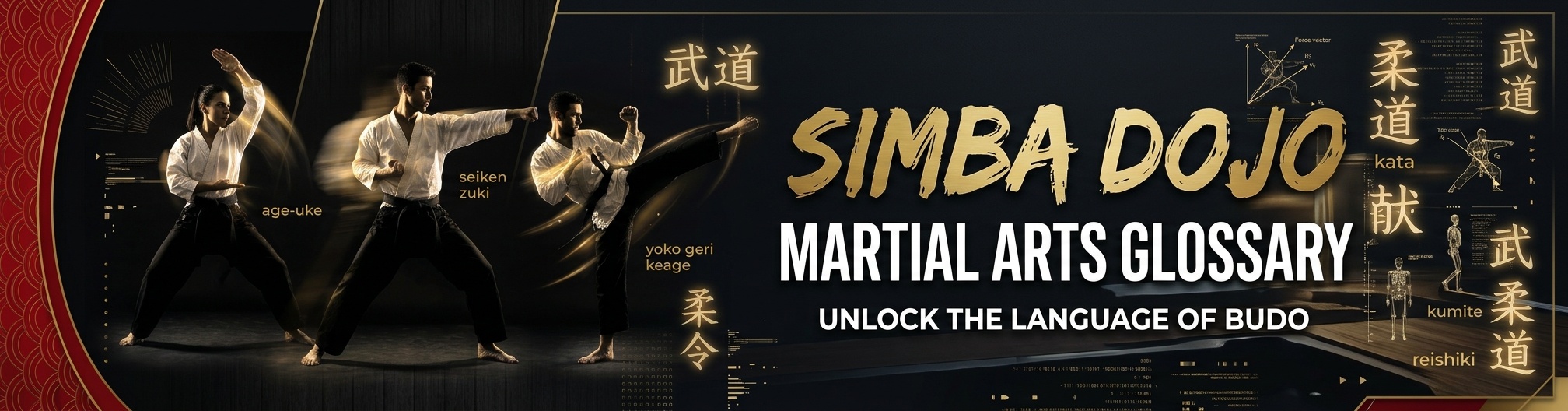
simba dojo glossary banner v2

Karate

Search for glossary terms (regular expression allowed)

Glossaries

Term Definition
Karate

Karate (空手), translated as "Empty Hand," is a traditional Okinawan and Japanese striking martial art that utilizes punches, strikes, kicks, knee strikes, elbow strikes, and open-hand techniques for self-defense and personal development.


Etymology & Historical Evolution

  • Original Kanji (唐手 — "China Hand"): Historically, the art was developed on the island of Okinawa by synthesizing indigenous Okinawan fighting methods (Te) with Chinese kung fu systems.

  • Modern Kanji (空手 — "Empty Hand"): In the early 20th century, led by pioneers such as Master Gichin Funakoshi, the first character was officially changed to Kara (空 — empty), reflecting both the physical reality of unarmed combat and the Zen philosophical concept of emptying the mind of ego, pride, and malice.

  • Karate-Dō (空手道 — "The Way of the Empty Hand"): The addition of the suffix -Dō (道 — path/way) signified its transformation from a purely combat art (jutsu) into a holistic Budo path dedicated to character forging, morality, and lifelong self-improvement.

Key Technical Mechanics

  • Biomechanical Power: Modern karate emphasizes body structure, deep grounded stances (dachi), core stability, and the explosive rotation of the hips (koshino kaiten) to generate force.

  • Kime (Focus): The instantaneous concentration of body power and muscle contraction at the split-second of impact, followed immediately by relaxation.

  • Hikite (Reactionary Pull): The synchronized retracting action of the non-striking hand to maximize rotational force and balance.

The Three Pillars (Sanbon-ba)

Karate training is structured systematically into three core components:

  1. Kihon (基本): Fundamental line drills to build technique, stamina, and posture.

  2. Kata (形): Choreographed formal patterns representing combat against multiple imaginary attackers.

  3. Kumite (組手): Structured and unscripted sparring to apply techniques against a live training partner.

Core Philosophy

Beyond physical striking, true karate is rooted in ethical conduct, humility, and self-restraint, summarized by Master Funakoshi’s famous maxim:

"Karate ni sente nashi" — There is no first strike in karate.

See the article: Simba Dojo - The Evolution of Karate: From Okinawan Tradition to Global Discipline

Author - Sensei Miller
Hits - 27
Synonyms: Empty hand, Karate-dō (空手道), Tōde / Tō-te (唐手), Okinawa-te (沖縄手) / Te (手), Ryūkyū Kempo (琉球拳法)
Ask a question
1000 characters left